13 Facts About Sforza Castle That Will Surprise You
The short answer
The clock tower you walk under blew up in 1521 and was rebuilt in 1905 from a painting. A duke rode his horse upstairs. A chapel was built for 22 singers and later used as a stable. And Michelangelo's last sculpture, which he was still carving days before he died, was once written off as modern. Thirteen facts, and you can stand in front of most of them.
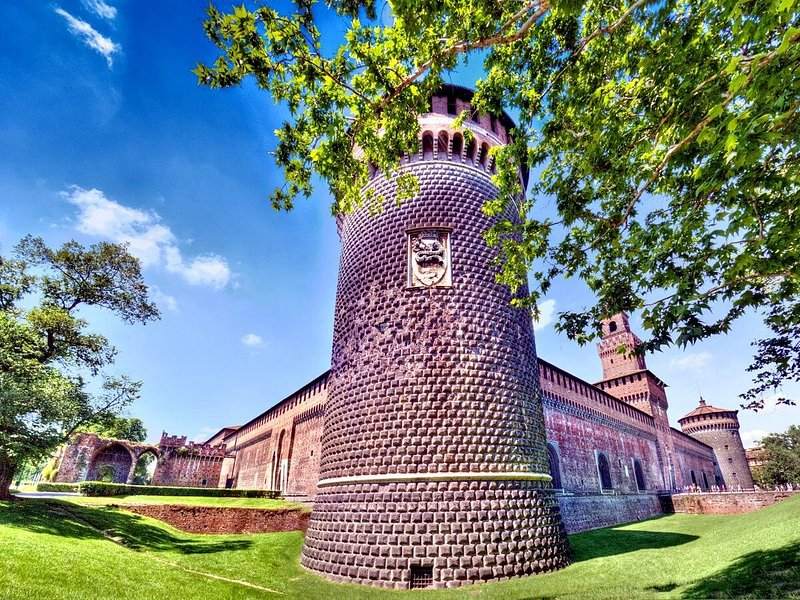
The Castello Sforzesco has been a ducal palace, a barracks and a museum. Each life left something behind. Read these before you go and the building stops being a backdrop. If you would rather have someone point them out, a sforza castle guided tour covers most of them in ninety minutes.
1. The gatehouse exploded in 1521
Filarete designed the tower you walk under in 1452. Later it was used as a gunpowder store, and in June 1521 it exploded. For almost four centuries after that, you would have seen no tall tower on the castle's city front at all.
2. It was rebuilt from a painting
When Luca Beltrami set out to rebuild it, he worked from a Leonardo-school painting, the Madonna Lia, and from a graffito at the Cascina Pozzobonelli. In 1895 he put up a full-size wooden model to test the design. The new Filarete Tower opened on 24 September 1905, dedicated to King Umberto I. The castle's towers are described one by one.
3. The winds are carved on top, and perhaps a signature
Look up at the lantern at the very top, and bring your zoom lens if you have one. The names of eight winds are carved around it, SEPTENTRIO and EURUS among them, which makes it a small Tower of the Winds. Beside a painted "LU" there is a painted "BE". It may be Beltrami's own initials, left high above the square where you would never think to look.
4. A staircase built for a horse
Galeazzo Maria Sforza's apartments in the Corte Ducale ran over two floors, joined by a staircase of low, shallow steps. It let the duke ride his horse up to the rooms above. The staircase belongs to the residence rather than the open courtyard, so ask your guide where it runs.
5. A portico named for an elephant
Benedetto Ferrini built the Portico of the Elephant in 1473. The name comes from the elephant in its fresco, so look up at the painting rather than for a statue. It stands in the Corte Ducale, one of the free courtyards, so you can find it before you buy a ticket.
6. The chapel was built for 22 singers
The Ducal Chapel was built and frescoed in 1473, by Benedetto Ferrini and Bartolomeo Gadio with painters including Bonifacio Bembo. It was made for a choir of 22 singers, recruited from across Europe. You find it in room XII of the Museo d'Arte Antica, on the standard €10 ticket. What to see puts it on a route through the ducal rooms.
7. Then the same chapel became a stable
After the Sforza, the castle spent three centuries as a barracks under Spanish, Austrian and French rule. In those years the Ducal Chapel was used as a stable. On 9 May 1796 the garrison inside numbered 2,000 soldiers, with 152 cannon. Keep that in mind when you stand in the chapel and try to picture horses there.
8. It sat inside a twelve-point star
From 1549 Ferrante Gonzaga surrounded the castle with a twelve-point star-shaped fortress. Inside it you would have found a pharmacy, a hospital, bakeries and two churches. The star was demolished from 1801, and Antolini's Foro Bonaparte plan for the site was abandoned.
9. The Milanese pulled it down once, and stripped it once
During the Ambrosian Republic, from 1447 to 1450, the Milanese partly demolished the Visconti fortress. Francesco Sforza, acclaimed lord of Milan on 25 March 1450, rebuilt it instead. In 1859, when the Austrians left, the Milanese stripped it again. It took Beltrami, from 1893, to turn it into the museum you visit today.
10. Michelangelo was carving days before he died
Michelangelo worked on the Pietà Rondanini over the last ten years of his life, probably from 1553–1555, reworking its proportions again and again. Daniele da Volterra's letters put him at it a few days before his death at 89. His workshop inventory of 19 February 1564 lists it as roughed out and unfinished.
11. It vanished, and an appraiser called it modern
For centuries the sculpture was untraced. It surfaces with certainty on 13 August 1807, in the collection of Marchese Giuseppe Rondinini, later spelled Rondanini. An appraiser there called it modern, which you may find hard to believe once you stand in front of it. It was sold with the palazzo in 1904, and the Comune di Milano bought it in 1952.
12. It lives in a Spanish military hospital
Since 2 May 2015 the Pietà has had its own museum in the Ospedale Spagnolo, the hospital of the Spanish garrison. The vault still carries the Apostles' Creed, painted for the sick soldiers. You can walk all the way round the sculpture. It has its own desk and lockers, yet it is on the same €10 ticket as every other museum. The eight museums are set out one by one.
13. An electronic music studio sits in the castle
The Museum of Musical Instruments holds about 900 instruments. It also holds the RAI Studio di Fonologia, the electronic music studio that ran from 1955 to 1983, where Berio and Maderna worked. You find it in room XXXVI, reached by the lift in the Rocchetta.
Where each fact lives
- Free, in the courtyards: facts 1, 2, 3 and 5, the tower, the winds and the elephant.
- On the €10 museum ticket: facts 6, 10, 11, 12 and 13, the chapel, the Pietà and the studio.
- In the story, not on the ground: facts 4, 7, 8 and 9, the horse staircase, the barracks, the star and the demolitions.
One more room belongs on any list, and you cannot see it yet. Ludovico il Moro brought Bramante and Leonardo to his court, and in 1498 Leonardo painted the Sala delle Asse as a pergola of trees. It is closed for restoration, and new monochrome fragments were found there in February 2015. A guide in the rooms around it will show you where it is.
The castle in dates
| Year | What happened |
|---|---|
| 1360–1370 | Galeazzo II Visconti builds the fortress of Porta Giovia |
| 1450 | Francesco Sforza becomes lord of Milan and rebuilds it |
| 1473 | The Ducal Chapel and the Portico of the Elephant |
| 1498 | Leonardo paints the Sala delle Asse |
| 1521 | The gunpowder store in the tower explodes |
| 1549 | The twelve-point star fortification begins |
| 1796 | 2,000 soldiers and 152 cannon inside |
| 1905 | The rebuilt clock tower opens |
| 1943 | Bombs burn two-thirds of the city's historical archive |
| 1952 | The Comune buys the Pietà Rondanini |
| 2015 | The Pietà museum opens |
The full chain, era by era, is on the history of the castle. The August 1943 raid also destroyed the north-west curtain wall of the castle.
The one to find first
Stand under the clock, look for "BE" beside "LU", and then go and find the elephant. The tours that walk you from one fact to the next are on Sforza Castle Tours.
Guides who show you the facts in place
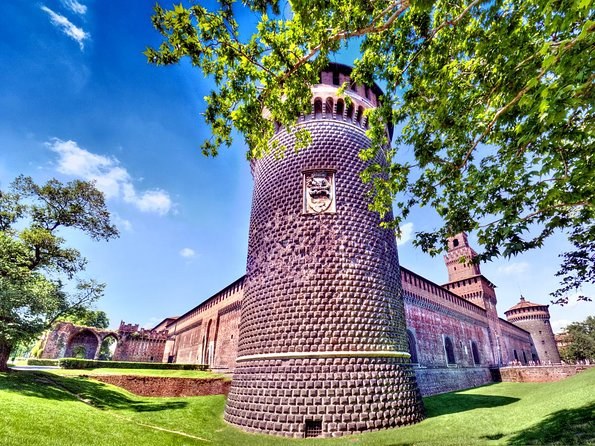
Sforza Castle and Michelangelo's Pietà Rondanini guided experience
Meet under the Filarete Tower; entry and a licensed guide included.
From $59 per person
Check Availability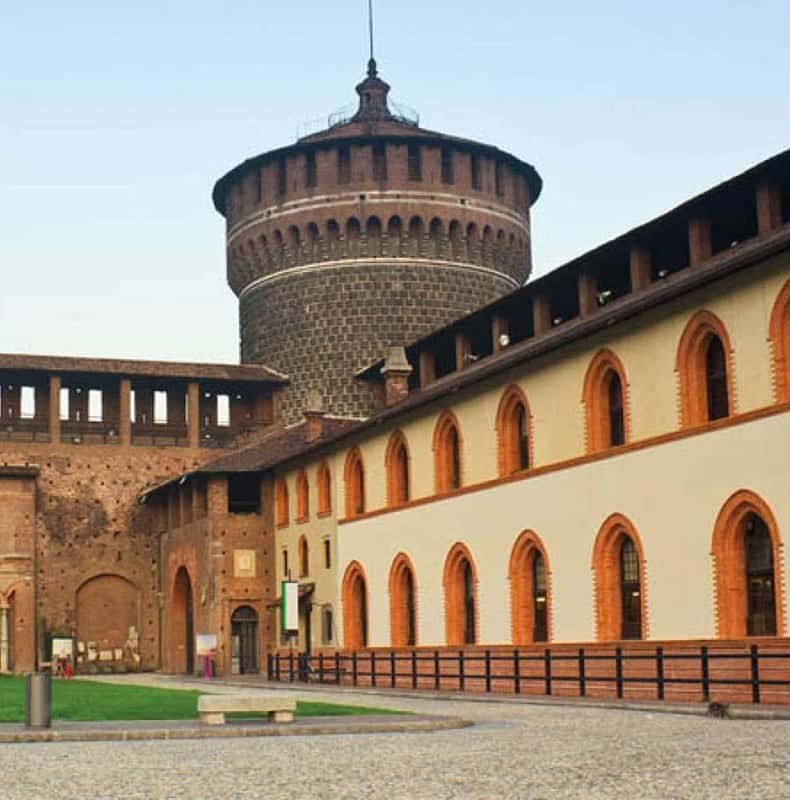
Guided Tour: Discover Sforza Castle and Michelangelo's Art
Michelangelo and Leonardo at the castle, ninety minutes, entry included.
From $94 per person
Check Availability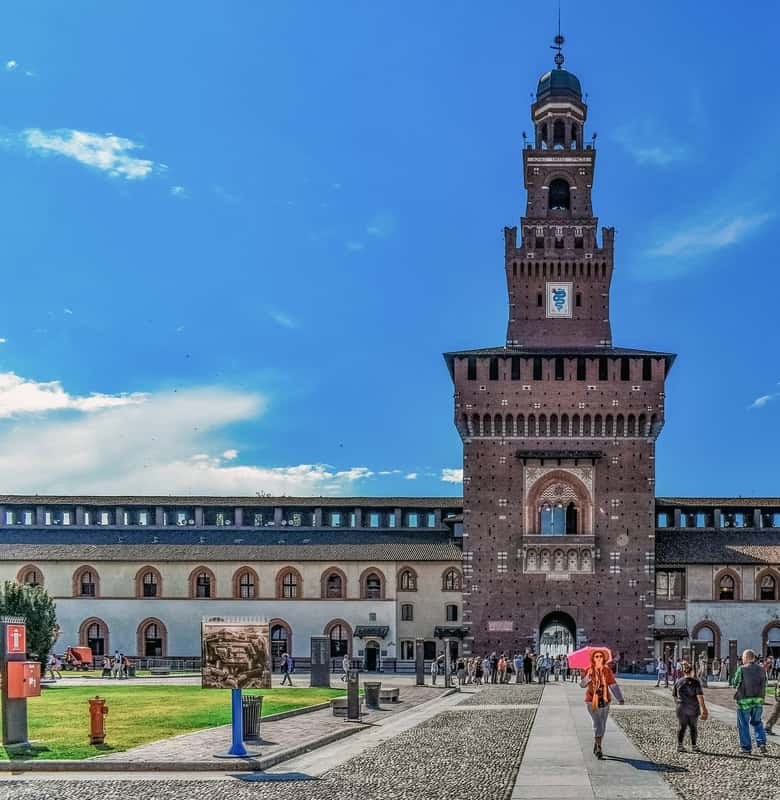
Milan: Sforza Castle and Michelangelo's Pietà Rondanini Tour
Ninety guided minutes inside, museum ticket included, the Pietà first.
From $58 per person
Check Availability