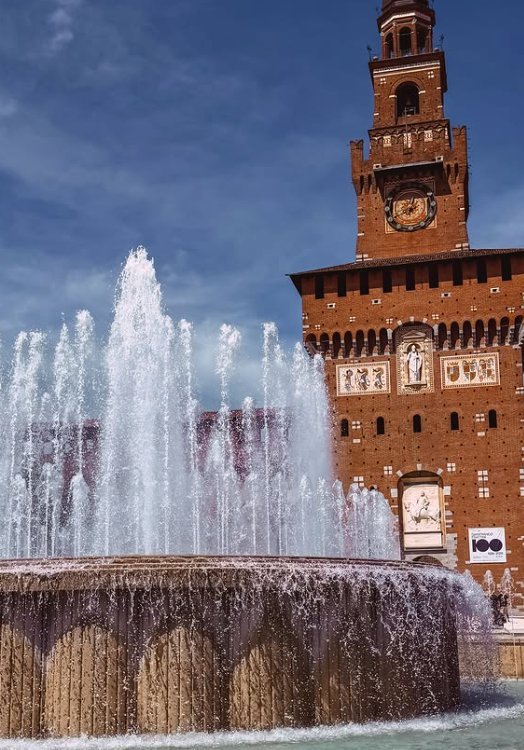
Sforza Castle has stood at the edge of Milan's old city for over 650 years, and in that time it has been a fortress, a ducal palace, a barracks, a ruin, and finally a museum. Its history is really the history of Milan itself — every political shift in the city left a mark on these walls. Here's the full story, from its medieval foundations to the museums you'll walk through today.
Origins Under the Visconti (1358–1450)
The first version of the castle was built between 1358 and 1368 by Galeazzo II Visconti, Duke of Milan, who called it the Castello di Porta Giovia after the city gate it stood beside. This wasn't a palace built for show — it was a heavily fortified residence, designed primarily to protect the ruling family from Milan's own notoriously unstable population as much as from external enemies.
For nearly a century, the Visconti castle served as both home and stronghold. But when the last Visconti duke died without a male heir in 1447, the city briefly declared itself the Golden Ambrosian Republic — and in the chaos, the castle was largely destroyed by Milanese citizens who saw it as a symbol of tyranny.
Francesco Sforza Rebuilds the Castle
The republic didn't last. By 1450, Francesco Sforza — a condottiero (mercenary general) who had married into the Visconti family — took control of Milan and immediately began rebuilding the castle, on a much grander scale. He brought in the Florentine architect Antonio Averlino, known as Il Filarete, who designed the central tower that still bears his name today: the Filarete Tower, the castle's iconic entrance.
Under the Sforza family, the castle stopped being purely defensive and became a genuine seat of ducal power — though its walls, moat, and corner towers never let anyone forget what it was built to withstand.
The Golden Age Under Ludovico il Moro
The castle reached its cultural peak under Francesco's son, Ludovico il Moro, who ruled Milan from 1494 to 1499. Ludovico turned the Sforza court into one of the great cultural centres of the Italian Renaissance, attracting artists and engineers from across Italy — including, most famously, Leonardo da Vinci, who spent 17 years in Milan working on everything from the painted ceiling of the Sala delle Asse to designs for the castle's moat defences.
The architect Donato Bramante also worked at the Sforza court during this period, contributing to the design vocabulary that would define the High Renaissance. For a brief window — roughly the 1490s — Sforza Castle was arguably as artistically significant as anything happening in Florence or Rome.
In 2012, conservators working in the castle's collections identified a group of preparatory sketches attributed to Caravaggio — over 400 years after they were made. Even after more than a century as a museum, Sforza Castle is still yielding new discoveries.
Decline: French Occupation, Spanish Rule, and Napoleon
The golden age didn't last. In 1499, French forces invaded Milan and Ludovico il Moro was eventually captured and imprisoned, dying in a French dungeon in 1508. Over the following three centuries, the castle changed hands repeatedly — French, then Spanish, then Austrian rulers each used it primarily as a military garrison, stripping away much of its Renaissance character in favour of practical fortification.
The lowest point came under Napoleon. After French forces took Milan in 1796, Napoleon ordered large sections of the castle's outer defences demolished, and the moat — partly designed under Leonardo's influence three centuries earlier — was drained. For a time, the castle's future as anything other than a military site seemed doubtful.
WWII Bombing and Modern Restoration
By the early 20th century, the architect Luca Beltrami led a major restoration that rebuilt the Filarete Tower (which had been destroyed by a gunpowder explosion centuries earlier, in 1521) and reimagined the castle as a public museum complex — a transformation completed in the early 1900s.
That museum complex then suffered serious damage during the Allied bombing of Milan in World War II. Several sections of the castle, including parts of the museum collections, were damaged or destroyed. The decades after the war saw a long, careful restoration effort to repair the structure and reopen its museums — a process that, in some areas like the Sala delle Asse, is technically still ongoing today.
If the history is what draws you in, pair your visit with our architecture and layout guide — it maps out exactly which parts of the castle date from which era, so you can see the Visconti foundations, Sforza-era towers, and 20th-century restorations side by side.
The Castle Today
Today, Sforza Castle houses nine separate civic museums — including the Pinacoteca (picture gallery), the Museum of Ancient Art with Michelangelo's Pietà Rondanini, the Egyptian Museum, and the Museum of Musical Instruments. The courtyards are free and open daily, and the surrounding Parco Sempione gives the castle one of the largest green spaces in central Milan.
Six and a half centuries after Galeazzo II Visconti built the first fortress on this spot, Sforza Castle remains exactly what it has always been: a mirror of whoever controls Milan, and a record of everything that's happened to the city since. For tour options and ticket prices, see our Sforza Castle tours page.